
The campus environment can be exciting and challenging. It can also be highly stressful since social and emotional concerns can interfere with effective functioning and academic performance.
We offer a holistic and collaborative model of care. We hope you find SHaW's mental health services to be a friendly, helpful place that provides services to help you be a successful student and a happy and healthy person!
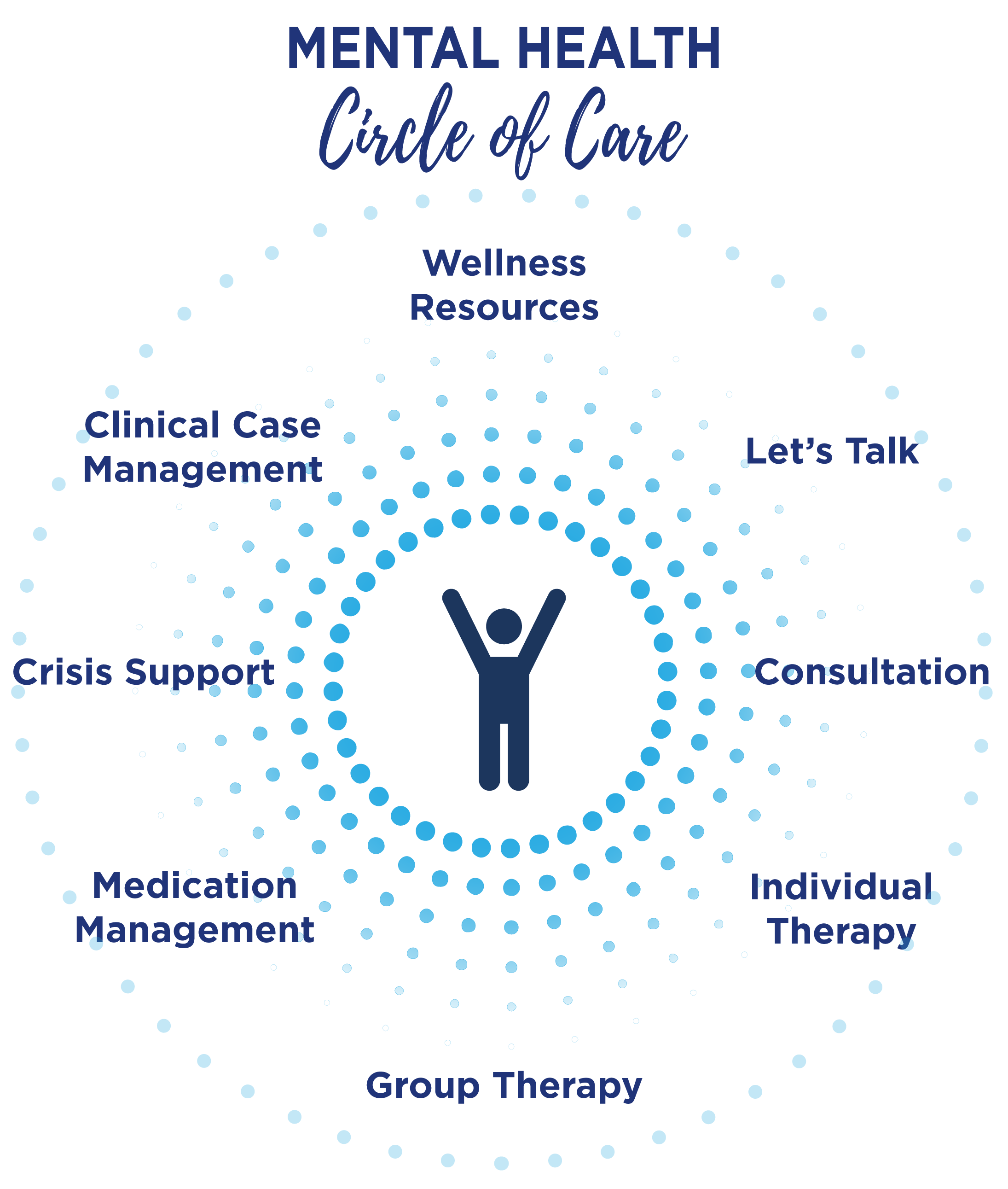
Mental Health Circle of Care
Student Health and Wellness' mental health services promotes and fosters the emotional and psychological growth and well-being of all students at UConn by providing a wide range of supportive services. Our staff is committed to providing quality care in a safe, confidential, and non-judgmental atmosphere. SHaW believes in a strengths-focused, biopsychosocial model of care that honors the fundamental dignity of each person.
The Circle of Care model allows students to access a variety of individual and group-based services specific to their needs. When recommending services, clinicians take into account the type of concerns students present with, their personality and preferences, readiness for change, and research on best practices. This personalized approach allows Student Health and Wellness to provide flexible and individualized services to support student mental health and wellbeing.
How do I get started?
Screening
What is a screening?
Generally, the first step for students to get support from Student Health and Wellness for mental health services is called a screening. These appointments are typically held over the phone. Screenings help us learn more about the types of support you are seeking. We will ask you questions like, “How can we help you?” as well as questions pertaining to your safety including thoughts about suicide and thoughts of harming others. We will discuss options for next steps that best address your needs. Resources and support may include a referral to a workshop, short-term individual or group therapy, discussion of medication services, and/or referrals to other campus or community resources.
How do I schedule a screening?
Crisis Support
Life Threatening Emergency – Call 911
If you are experiencing a serious and immediate life-threatening crisis, please bypass calling Student Health and Wellness and call 911 or the UConn Police Department immediately. Although most people associate 911 with medical emergencies, they also support people with mental health emergencies such as thoughts of suicide.
I need to talk to someone now:
BeWell@UConn offers free and confidential mental health support 24/7/365.
U.S., Canada, and the Caribbean
All Other International Locations
Examples of a mental health crises include: thoughts or plans to hurt yourself or someone else, engaging in life-threatening behaviors, and/or recent assault or trauma.
State and National Resources:
Crisis Text Line – Text HOME to 741741
National Suicide Prevention Lifeline – Call or Text 988
Connecticut Alliance to End Sexual Violence – 1-888-999-5545
Rape, Abuse & Incest National Network (RAINN) – 1-800-656-4673
National Domestic Violence Hotline – 1-800-799-7233
Local Hospitals:
Manchester Memorial Hospital
71 Haynes St., Manchester, CT 06040
860-646-1222
Rockville General Hospital
31 Union St., Vernon, CT 06066
860-872-0501
Windham Hospital
112 Mansfield Ave., Willimantic, CT 06226
860-456-9116
Grief & Loss
Loss is an inevitable part of life, and grief is a natural part of the healing process. The reasons for grief are many, such as the loss of a loved one, the loss of health, or the letting go of a long-held dream. Dealing with a significant loss can be one of the most difficult times in a person’s life.
Different Kinds of Loss:
Feelings of loss are very personal, and only you know what is significant to you. People commonly associate certain losses with strong feelings of grief. Examples of losses are:
- Loss of a close friend
- Death of a partner
- Death of a classmate or colleague
- Serious illness of a loved one
- Relationship breakup
- Death of a family member
Subtle or less obvious losses can also cause strong feelings of grief, even though those around you may not know the extent of your feelings. Some examples include:
- Leaving home
- Illness/loss of health
- Death of a pet
- Change of job
- Move to a new home
- Graduation from school
- Loss of a physical ability
- Loss of financial security
Normal Grief Reactions:
When experiencing grief, it is common to
- Feel like you are “going crazy”
- Have difficulty concentrating
- Feel sad or depressed
- Be irritable or angry (at the deceased, oneself, others, higher powers)
- Feel frustrated or misunderstood
- Experience anxiety, nervousness, or fearfulness
- Feel like you want to “escape”
- Experience guilt or remorse
- Be ambivalent
- Feel numb
- Lack energy and motivation
Remember that grief is a process of healing. The grief process is not linear, but is more often experienced in cycles. Grief is sometimes compared to climbing a spiral staircase where things can look and feel like you are just going in circles, yet you are actually making progress. Being patient with the grieving process and allowing yourself to have any feelings about the loss can help. If you feel stuck in your grief, talking to a counselor or a supportive person may help you move forward in the healing process. Student Health and Wellness offers a variety of supports to students who have experienced a loss.
Sudden versus Predictable Loss:
Sudden or shocking losses due to events like crimes, accidents, or suicide can be traumatic. There is no way to prepare. They can challenge your sense of security and confidence in the predictability of life. You may experience symptoms such as sleep disturbance, nightmares, distressing thoughts, depressed mood, social isolation, or severe anxiety. Predictable losses, like those due to terminal illness, sometimes allow more time to prepare for the loss. However, they create two layers of grief: the grief related to the anticipation of the loss and the grief related to the loss itself.
How Long Does Grief Last?
The length of the grief process is different for everyone. There is no predictable schedule for grief. Although it can be quite painful at times, the grief process should not be rushed. It is important to be patient with yourself as you experience your unique reactions to the loss. With time and support, things generally do get better. However, it is normal for significant dates, holidays, or other reminders to trigger feelings related to the loss. Taking care of yourself, seeking support, and acknowledging your feelings during these times are ways that can help you cope.
Online Resources:
- American Foundation for Suicide Prevention – comprehensive resources for survivors of suicide
- HelpGuide – information on coping with the grieving process
Programs, Events and Additional Services
Yoga, Meditation, & Mindfulness
Let’s Talk
What is it?
The Let's Talk program provides informal, confidential consultation with therapists from SHaW. The service is free of charge and offered on a first come, first served basis. More info like dates, time and location can be found here.
Clinicians provide support, coaching, and connect students to other campus resources as needed. Although therapists provide this service, it is not a substitute for formal counseling. The Let's Talk program is also not suited to treat mental health emergencies; students who are experiencing a mental health crisis should see Crisis Support tab above.
Who is it for?
Students who may benefit from attending a Let's Talk session include:
- Students who want help connecting to resources but are unsure where to begin
- Students who are looking for advice on a non-clinical issue
- Students who are unsure about therapy and are curious about what it is like to talk to a therapist
- Students who may have concerns about the mental health of a friend and seek advice on how to support their friend
If a student is not an imminent risk, and is refusing your support in contacting our office, you may also consider contacting the UConn Student CARE Team.
How is this program beneficial?
Let's Talk creates space for students to seek immediate support for non-crisis concerns. By doing so, we support students in need before they reach the level of crisis. Furthermore, Let's Talk contributes to our social justice mission by reducing barriers to mental health services for student populations who are less likely to seek formal mental health treatment.
*The Let's Talk & Consultation service is inspired by Cornell University’s Let’s Talk program.
NCAA Student Athletes
UConn BIPOC/Minority Mental Health Panel – July 2021
- Services
- Immediate Care
- Alcohol, Other Substance Use & Support
- Allergy Clinic
- Fees & Insurance
- Immunizations
- Injury & Illness
- Lab Testing
- Mental Health
- Nutrition
- Overnight Care
- Pharmacy
- Physical Activity
- Preventive Care & Health Screening
- Radiology
- Recovery Support Services
- Sexual & Reproductive Health
- Sports Medicine
- Travel Medicine
- Wellness Coaching
Regional Campus Students:
All UConn Regional Campus Students can find links to SHaW services and programs here.
Scheduled Appointments
Brief Individual Therapy
Student Health and Wellness (SHaW) offers brief, goal-oriented individual therapy to support students in managing their mental health concerns. Students commonly seek therapy for difficulties such as anxiety, depression, grief, trauma, eating and exercise difficulties, addiction, relationship difficulties, and academic problems. SHaW mental health clinicians provide a safe and non-judgmental environment for students to discuss their challenges and learn new ways of coping. Many students find benefit after one session of therapy, and some students find that additional sessions are useful. For students who are seeking or would benefit from more intensive treatment, we offer assistance in connecting you to appropriate local providers who have experience in working with college students.
If you’re interested in our services, please schedule a brief assessment with a clinician who will assist you in determining what services will best fit your specific area(s) of concern.
Group Therapy
For many concerns that undergraduate and graduate students face – like overwhelming stress, anxiety, difficult relationships, depression, academic difficulties, and more – group therapy is the best option for support and healing.
More info about our Group Therapy and schedule is found here.
Psychiatric Services
In consultation with your Student Health and Wellness therapist, you may decide your presenting problem is more thoroughly understood as a medical illness that could benefit from psychiatric medication in conjunction with your counseling therapy. To help you decide if medications would be beneficial for you, your SHaW therapist may arrange for you to have a psychiatric assessment with a SHaW psychiatrist or an advanced practice registered nurse.
If you are receiving services from a community-based therapist off campus, you are expected to receive your medication services from a community provider as well. Your community-based therapist can assist you in finding a medication treatment provider in the community with whom they regularly collaborate.
In meeting with your SHaW psychiatrist or advanced practice registered nurse, your provider will assess your needs and discuss recommendations for your care. Your medication assessment will conclude with an opportunity to ask questions during a discussion of benefits, risks, side effects of medications, as well as alternatives to medical treatment. Once you have started taking medication, your treatment provider will plan follow up appointments with you at regular intervals to make sure that your treatment is working and that you are not experiencing any unexpected side effects. It is important to keep your follow up appointments so that you and your care provider can monitor your response to treatment, track your progress, and make adjustments as necessary. As your symptoms come into control, the frequency of appointments for medication monitoring will typically decrease.
Psychiatric medications work by influencing chemical processes in your brain. Depending on which medication you have been prescribed and the reasons you are taking them, the rate of recovery can be highly variable. Some medications have fast-acting effects and start improving symptoms almost immediately. However, most medications take weeks or even months before they achieve their full beneficial result. Your psychiatrist, nurse, or pharmacist can help you set realistic expectations about how long it might take for you to start experiencing benefits from your medication.
Medication Tips
Managing Your Medication
As a busy student, it requires special attention to remember to take your medication. The university environment can present some predictable challenges to managing your medication. Check out these strategies that may help you notice and overcome any challenges you may encounter.
Develop a Strategy for Remembering to Take Your Medications
- Use a pill box or medication organizer. These can help you remember to take your medication each day and prevent you from accidentally forgetting or from taking a duplicate dose. Once a week, fill your medication organizer with your pills for the entire week. It’s helpful to schedule this activity into your calendar so that it becomes a routine you perform at the same time each week. Keep the pill box in a place where you will see it every day (e.g., with your keys or next to your toothbrush).
- Take your pills at approximately the same time each day.
- Set an alarm. Especially when first starting a new medication, it’s helpful to set an automated reminder or alarm on your computer or phone. Keep using the electronic reminders until you are confident that taking your medication has become a consistent part of your everyday routine.
Helpful Tools for Managing Medications and Monitoring Your Progress
- Keeping a diary of both benefits and side effects can provide helpful information for you and your provider to consider when making future decisions together about your treatment plan. A Weekly Medication Log may help you keep track of your treatment experience. You can also try the Tracking Medication Benefits Worksheet.
Feeling Better and Keeping it That Way
- The goal of treatment is to help you feel better and keep you feeling better. If you have ever been prescribed an antibiotic for an infection, you know that your provider will remind you to take all of the medication until it is finished, even if after you start to feel better. Taking your medications as directed is especially true when in treatment for a mental health condition. Most mental health disorders are time-limited, but still require many months of treatment with medication to ensure a full recovery. Some psychiatric conditions are chronic, however, and require ongoing treatment for symptom management.
- Stopping your medication prematurely once your symptoms improve can put you at risk for experiencing a potentially dangerous side effect or an undesirable relapse of symptoms. Always check with your psychiatric provider before stopping or adjusting your medication.
Alcohol and Drugs
- The use of drugs and alcohol can bring on symptoms of mental health conditions (e.g. depression, anxiety, psychosis, etc.), or can cause your symptoms to become even worse. While the use of drugs and alcohol come with risks for anyone, the risks may be much greater for individuals with mental health disorders and for those taking psychiatric medications.
- People with mental health disorders are significantly more likely than most people to develop an alcohol or drug dependency problem. For example, patients with Bipolar Disorder have a nearly 75% greater risk of developing an addiction to substances than does someone without this mental health illness.
- Mixing drugs and alcohol can lead to potentially dangerous and even lethal effects, when combined with certain psychiatric medications. Drug and alcohol use can make treating or managing a mental health disorder much more difficult, even among people who have control over their drinking or drug use.
- If you are taking psychiatric medication and are using or considering the use of any drugs or alcohol, consult your psychiatric medication provider about safety first. Your provider’s primary objective is to help you remain healthy and safe, and not to judge or reprimand you. Be open and honest with your providers to learn more about your medications and safety in making an informed decision about your drug or alcohol use.
- Visit the Food and Drug Administration webpage for more safety information about the psychiatric medications that you are prescribed.
- Information about the dangers of mixing medications and alcohol provided by the UConn Center for Students with Disabilities.
Medication Side Effects
Keep Your Medications Out of Sight
- Some of the medications you may be prescribed can be misused as drugs of abuse. Be discrete about who you tell about your medications. Keep your medications safely put away, out of sight, and even locked in a lock box if you believe you are at risk of having them stolen.
Side Effects and Medication Reactions
- Psychiatric medications can come with unwanted side effects. Before prescribing a new medication, your provider will review any predictable side effects that you may experience and any potential for more serious reactions. Even though the side effects from psychiatric medications are to be expected, in most cases these are mild and go away after a short time. For some people, however, side effects can persist for an indefinite period of time and may require you to consult with your provider for management strategies.
- Side effects are likely to occur within the first two weeks of either starting a new medication or increasing the dosage. Often side effects are a temporary reaction to the medication, and go away once your body adjusts. If you have questions about the side effects that may occur due to your psychiatric medications, or if you start experiencing new side effects from your medication, talk to your medication provider or your pharmacist right away.
- It can sometimes be difficult to distinguish a psychiatric medication side effect from one of the symptoms of the mental health condition for which you are being treated. For example, some people experience some tiredness when taking medications, while low energy can also be one of the symptoms of depression. Consult your medication provider to help you assess any persistent psychiatric symptoms and/or side effects that you may be experiencing.
- In the rare event that you experience a serious allergic reaction (e.g. a problem breathing or swallowing, or hives) immediately consult your medication provider, report to your local emergency room for an evaluation, or phone 911.
Consult your Provider
Consult Your Provider Before Changing Your Medication Plan
- If you develop side effects, talk to your treatment provider. Never stop or adjust your medication on your own. Often your provider can offer recommendations that may reduce or eliminate side effects.
- For most mental health conditions, there is likely to be more than one medication available that may work for you. If you having too much difficulty with side effects, your provider may recommend that you try a different medication to find the one right for you.
Keep All of Your Doctors, Nurses, and Pharmacists Informed About All of Your Medications
- It is extremely important to tell your provider and pharmacist about all of the medications (prescription and non-prescription) you are taking. Similarly, if you should be prescribed a new medication by a provider other than your psychiatric provider, always inform them of any psychiatric medications. All of your providers can check if there are any drug interactions that may result in unwanted side effects or that may affect your psychiatric treatment.
Paying for Medications
- The price of psychiatric medication can be highly variable, and sometimes students don’t fill their prescriptions because of cost.
- Ask your provider or pharmacist about generic drugs options rather than brand names to save money. Generic prescriptions contain the same active medication as brand name drugs and are usually less expensive.
- Some discount stores have pharmacies with low-cost prescription programs (e.g. Wal-Mart, Target). In addition, some pharmaceutical companies have programs for those who cannot afford the full price. Consult with your pharmacist to learn if you qualify for a program to help you pay for medication.
- You can save money by inquiring with your insurance plan’s Pharmacy Benefits Management program about mail order prescriptions or larger quantity discounts. Some insurance plans have programs that allow for 90 day refills and / or mail order medications that can save on the cost of your treatment.
- In factoring the financial cost of your treatment, remember that treatment could save money in the long run by helping you avoid unwanted consequences of an untreated medical condition. Untreated mental health disorders could lead to expensive medical visits, hospitalization, lost wages from missed work, poor academic and job performance, and additional tuition from a prolonged academic career.
Being Away from Campus
Long Academic Breaks, Study Abroad, and Other Travel Considerations
- Before you leave home, count your travel days to make sure you have enough medication to last through your entire trip. Be sure to have your prescription refilled before leaving or call your provider if you do not have sufficient medications to return home from your travels.
- If you are planning to be away from home for more than one month, consult with your pharmacist or medication provider about obtaining an early refill authorization to ensure you can take additional medications with you on your trip.
- If you are taking a medication that requires you to have blood drawn frequently, contact your provider to find out if you need to have blood work done before you leave, or at a facility away from home during your travels.
- Always travel with your insurance information and your provider’s telephone number in case you require medical attention while away from home.
- If you are traveling by air, always pack your medication in your carry-on luggage to avoid being without your medication should your luggage get lost or delayed in arriving at your destination. Make sure that you travel with your medications in the pharmacy issued bottles that bear your name and the name of the medication.
- When traveling internationally, some countries may ask to see a paper copy of your physician issued prescription to document even if your medications are in pharmacy-issued bottles. Make a copy of your prescriptions before having them filled at your pharmacy so that you can include copies of your prescriptions with your international travel documents.
- If you are studying abroad, consult with the coordinator of your study abroad program for information about how to locate medical providers abroad in case of any emergencies. Alert your medication provider of your plans to travel abroad to discuss how best to stay in contact if you need a refill or a consultation.
Long Breaks Away from Campus
- When you are away for summer break, or any breaks of one month or longer, consult with your provider for instructions on how to get your prescriptions filled while you are away. It may be helpful to identify another provider in the area where you are traveling in the event that you require medical attention or a prescription while you are away.
- Be sure to take your insurance information and your medication provider’s phone number with you.
- When traveling within the United States, larger national chain pharmacies are able to transfer your authorized refills from one store to another store within their chain. Transfers between different chain pharmacies are also possible, but require a little more coordination between pharmacies. Before you leave, consult with your local pharmacist about how to arrange for an electronic transfer of refills to a pharmacy located in or near your travel destination. Make sure that your provider has authorized enough refills to ensure that your medications will not be interrupted while you are away.
Medication with Off-campus Providers
Student Health and Wellness provides no actual endorsement of these practitioners who have submitted information to SHaW declaring their interest in being on a SHaW referral list for UConn students. Because mental health treatment is an ongoing commitment, it is important that you find care provider with whom you feel comfortable. Good care providers don’t just prescribe medication; they listen to your concerns, help you overcome difficulties, and make treatment a collaborative process. See here for referral information.
Referral Services
Some students may prefer to seek therapeutic services elsewhere. The Storrs and Connecticut community is also home to a number of private practice clinicians. If you would like assistance with the referral process, please contact our office.
In partnership with Thriving Campus, SHaW offers an online database and referral platform for community-based mental health providers at Thriving Campus. UConn students have the ability to search providers in their area based on their mental health and insurance needs as well as preferences related to providers’ identities. Thriving Campus partners with colleges and universities across the nation to provide a comprehensive list of licensed providers.
Psychological Services Clinic
Department of Psychology, University of Connecticut
Bousfield Building, 2nd Floor
406 Babbidge Rd., U-1020
Storrs, CT 06269
860-486-2642
SHaW provides no actual endorsement of these practitioners who have submitted information to SHaW declaring their interest in being on a SHaW referral list for UConn students. Because mental health treatment is an ongoing commitment, it is important that you find care provider with whom you feel comfortable.
Documentation, Accommodations, and More
Gender Affirmation Support
Student Health and Wellness therapists are open and affirming to students who wish to address issues related to sexuality, gender expression, and gender identity. For students seeking assistance during their gender transition process, SHaW therapists can provide both therapeutic support as well as letters for gender-related medical interventions as indicated in the course of therapy. With a student’s written permission, we also collaborate with SHaW medical providers.
If you’re interested in SHaW – Mental Health services, please complete a brief assessment with one of our clinicians. For further information about campus and community resources, please visit the UConn Rainbow Center.
Requests for Academic Accommodations
Students who are seeking accommodations based upon mental health concerns, particularly for time-limited or immediate issues, are encouraged to negotiate directly with their professors. SHaW – Mental Health staff may provide students with a “Verification of Visit Form” to verify a student’s consultation at SHaW on a specific date. SHaW – Mental Health staff will not write directly to professors to request accommodations on behalf of a student.
If students would like guidance regarding their enrollment, withdrawal, or academic status, they will be referred to the Dean of Students (DOS) office. SHaW – Mental Health staff may provide DOS with specific information about treatment (if needed) with a signed release of information.
All other academic accommodations are administrated through the Center for Students with Disabilities (CSD). With a signed release of information, SHaW – Mental Health staff can provide the CSD with clinical information to assist in their determination pertaining to an accommodation.
Requests for Documentation relative to Dismissal Appeals and Financial Aid Decisions:
Students seeking evidence of mental health concerns as part of an appeal processes on campus (often regarding academic dismissal and financial aid decisions) will be provided with documentation of their work with SHaW. This documentation will verify visit dates, and indicate degree of compliance with treatment recommendations. Disclosure of diagnostic information will be limited to individuals who are sufficiently licensed to interpret this information, and who are engaged in the patient’s care. Per our accrediting body, the International Association of Counseling Services (IACS), SHaW – Mental Health does not make admissions, disciplinary, curricular or other administrative decisions involving students. Per state privacy law, disclosures for the purposes of appeals require a written release of information.
Training Programs
Suicide Prevention
Ask, Listen, Refer (online suicide prevention training)
Brief Individual Therapy
Who is eligible for therapy at SHaW - Mental Health?
All registered students at Storrs are eligible for services. Sometimes other persons important in your life, such a partner, spouse, or friend may be involved in the therapy process as well and do not have to be a UConn student.
If it is an emergency, call 911.
If I go to SHaW Mental Health for help, does it mean there is something wrong with me?
No. Students who use mental health services are interested in their personal growth and adjustment in the world around them. Students face normal developmental concerns and academic pressures while UConn and may feel anxious, angry, lonely, or depressed. SHaW staff members are trained professionals and supervised graduate assistants who help students explore alternative coping strategies and ways of dealing with themselves and their environment.
Isn’t it better for me to solve my own problems?
A therapist doesn’t solve your problems for you. Rather, they help you clarify issues so you can solve problems on your own with a therapist’s guidance, support, and expertise. The goal of therapy is to make you more self-sufficient, not more dependent.
Will anyone be told I have come to SHaW Mental Health?
No. We have a strict confidentiality policy and will not release information regarding contact with a student without permission from the student except in a few excepted areas. If a student is 18 years of age, it is the student’s right to choose whether to discuss their use of mental health services with parents, friends, academic advisors, or prospective employers.
Why do people consider using therapy?
Therapy is a partnership between an individual and a professional who is trained to help people understand their feelings and assist them with changing their behavior. People often consider therapy under the following circumstances:
- They feel an overwhelming and prolonged sense of sadness and helplessness in their futures.
- Their emotional difficulties make it hard for them to function day to day.
For example, they are unable to concentrate on assignments and their class performance suffers as a result. - Their actions are harmful to themselves or others.
- They are troubled by emotional difficulties facing family members or close friends.
- They just need someone with whom to talk.
What can I expect at my first individual therapy appointment at SHaW Mental Health?
What are the benefits of psychotherapy?
If I begin therapy, how should I try to gain the most from it?
There are many approaches to therapy and various formats in which it may occur–including individual, group, and couples. Despite the variations, all therapy is a two-way process that works especially well when you and your therapist communicate openly. Research shows that the outcome of therapy is improved when the therapist and the client agree early about what the major problems are and how therapy can help.
You and your therapist both have responsibilities in establishing and maintaining a good working relationship. Be clear with your therapist about your concerns that may arise. Therapy works best when you attend all scheduled sessions and give some forethought as to what you want to discuss during each session.
Therapy isn’t easy. But individuals willing to work in close partnership with their counselor or psychologist often find relief from their emotional distress and begin to lead more productive and fulfilling lives.
How can I evaluate whether therapy is working?
As you begin therapy, you should establish clear goals with your therapist. Perhaps you want to overcome feelings of hopelessness associated with feelings of depression. Or maybe you would like to control fear that disrupts your daily life. Keep in mind that certain tasks require more time to accomplish than others. You may need to adjust your goals depending on how long you plan to be in therapy.
After a few sessions, it is a good sign if you feel the experience is a joint effort and that you and your therapist enjoy a comfortable relationship. On the other hand, you should be open with your therapist if you find yourself feeling “stuck” or lacking direction once you have been in therapy awhile.
You may feel a wide range of emotions during therapy. Some qualms about therapy that you may have might result from the difficulty of discussing painful and troubling experiences. When this happens, it can actually be a positive sign that you are starting to explore your thoughts, emotions, and behaviors.
You should spend time with your therapist periodically reviewing your progress. Although there are other considerations affecting the duration of therapy, success in reaching your primary goals should be a major factor in deciding when you should end therapy.
Group Therapy
What are the goals of group therapy?
People who participate in counseling groups benefit in many ways. At SHaW Mental Health, we believe groups are uniquely suited to help students:
- give and receive support
- gain understanding of problems and explore possible solutions
- practice interpersonal skills in a safe group setting
- learn more about how you come across to others
- increase observation and feedback skills
- enhance problem-solving skills
- improve emotional expressiveness
- decrease social isolation
- develop good communication skills
How often do groups meet?
A. Generally groups meet weekly in the fall, spring, and summer semesters. Each group is scheduled for a particular day of the week and time of the day that is set for the duration of the group. Typically, group sessions last for 90 minutes.
Is there a limit to the number of counseling group sessions I can have?
There is no limit on group sessions. We hope you will utilize our group program as much as you would like.
How do I make the most of group therapy?
Suggestions:
- Attend regularly. In joining the group, you have made a commitment to the other group members as well as to yourself.
- Make the group part of your life. Don’t think of group as something that happens once a week and then forget about it in between. Between group sessions, think about what happened in group and about how you felt during and after group, and try to figure out why you had those feelings.
- Take responsibility for your counseling and your group. It’s your group, so if it is not moving in the direction you want, say so.
- Participate actively. You will make more progress if you get actively involved in the group discussions.
- Experiment with new forms of behavior. Until you begin to act differently, you won’t change.
- Take some emotional risks in group. It is structured to be safe and supportive.
- Be as honest and open as you are able in group. It allows other group members to get to know who you really are.
- Speak in the first person. This makes what you say much more personal and powerful.
- Accept responsibility for your own experience and allow other to be responsible for theirs. Don’t foster dependency by assuming responsibility for others in the group.
- Learn to listen to others attentively. If you are formulating your response while someone else is speaking, you are not really hearing what is being said.
- Learn to differentiate between thoughts and feelings…when you say “I feel that…”, or “I feel like…”, you are moving away from expressing feelings to expressing thoughts.
- Speak directly to individuals in the group rather than about them to others.
- Be honest and direct with your feelings in group in the present moment, especially your feelings toward other group members and the therapists.
- Be spontaneous. Often we wait our turn to speak, try to be polite, or think about what we want to say for so long that the moment to say it has passed.
- Be specific and direct with your feedback.
- Share both positive and negative.
- Don’t give advice and suggestions.
- Don’t try to solve other member’s problems for them.
- Don’t blame or judge others.
- Be respectful, even when you don’t agree with a person’s position or behavior.
- Phrase your feedback so it is about your experience of the other person, and not a judgment of how they are.
- Ask for feedback when you need it, seek clarification and avoid becoming defensive or making excuses.
Are there ground rules for participating in group therapy?
The group sessions are confidential. The identity of the members of the group, and what they say in group is not to be talked about with anyone outside the group at any time. It is up to each group member to maintain this confidentiality.
Attend regularly and punctually. If you are going to miss a session or be late, please let one of the leaders of the group know.
Mutual respect is essential to maintaining the safety of the group. It is okay to disagree with others. It is not okay to treat other members disrespectfully.
Having a feeling and acting on it are two different actions. Acting out your feelings in group is not acceptable, whether you act them out upon yourself or on another member. The way we most respect ourselves and others is by experiencing our feelings and then talking about them.
It is your responsibility to talk about your reasons for being in the group as honestly as you are able.
If you decide to leave group, because you have met your goals for treatment or because it isn’t the most appropriate treatment method for you, we ask that you discuss this with the group facilitator first and then come to the group and say good-bye.
What about confidentiality?
That’s one of the common misunderstandings about group therapy:
“Group therapy will take longer than individual therapy, because I will have to share the time with others.”
Group therapy can be more efficient than individual therapy for two reasons. First, you can benefit from the group even during sessions when you say little by listening carefully to others. You will find that you have much in common with other group members, and as they work on a concern, you can learn more about yourself. Second, group members will often bring up issues that strike a chord with you, but which you might not have been aware of or brought up yourself.
“I will be forced to tell all of my deepest thoughts, feelings and secrets to the group.”
No one will force you to do anything in group counseling. You control what, how much, and when you share with the group. You do not have to share what you are not ready to disclose. You can be helped by listening to others and thinking about how what they are saying might apply to you. When you feel safe enough to share what is troubling you, a group will likely be very helpful and affirming.
“I have so much trouble talking to people, I’ll never be able to share in a group.”
Most people are anxious about being able to talk in group. Almost without exception, within a few sessions people find that they do begin to talk in the group. Group members remember what it is like to be new to the group, so you will get a lot of support for beginning to talk in the group.
Medication
Where can I find reliable patient education materials and other information about my psychiatric medications?
Who Can Prescribe Psychiatric Medications?
- Psychiatrists are medical doctors who specialize in the assessment and treatment of mental health concerns.
- Advance Practice Registered Nurses, Clinical Nurse Specialists, and Nurse Practitioners are registered nurses with advanced training in the assessment and treatment of medical and/or mental health concerns.
- General Practitioners (e.g., Primary Care Providers) are medically trained professionals who are able to prescribe any form of medication (including psychiatric medication) but do not specialize in mental health treatment. For many psychiatric conditions, you may be comfortably treated for a general mental health concern without needing to see a more specialized mental health treatment provider.
What Other Treatments Are Available for Mental Health Conditions Other Than Psychiatric Medications?
- Counseling is often an excellent first line treatment for many of the mental health concerns that students encounter. Depending upon the specific mental health concern and your individual circumstances, counseling can be just as effective as medications. In fact, in some cases, counseling alone can be more effective than medication. Whenever medications are medically necessary, however, an integrated approach that combines the use of psychotherapy and medication is most effective.
If I Am Prescribed Psychiatric Medications, How Long Can I Expect to Take Them?
- The duration of psychiatric medication depends on many factors, which include your diagnosis, the severity of your symptoms, a family history of mental health concerns, and whether or not your treatment plan includes other services like counseling. For some mental health concerns such as schizophrenia and bipolar disorder, practicing good mental health management skills and taking medication is almost always a lifelong part of a comprehensive treatment plan. For most other mental health concerns, treatment with medication will require a commitment of just less than one year.
Is it OK to Try One of My Friend’s Medications to See if They Work for Me Before I Commit to Taking a Medicine Myself?
- It is extremely dangerous to take another person’s medications or to share your medications with another person. Obtaining, or attempting to obtain, or using medications in a fraudulent manner is not only dangerous, but is against the law.
